
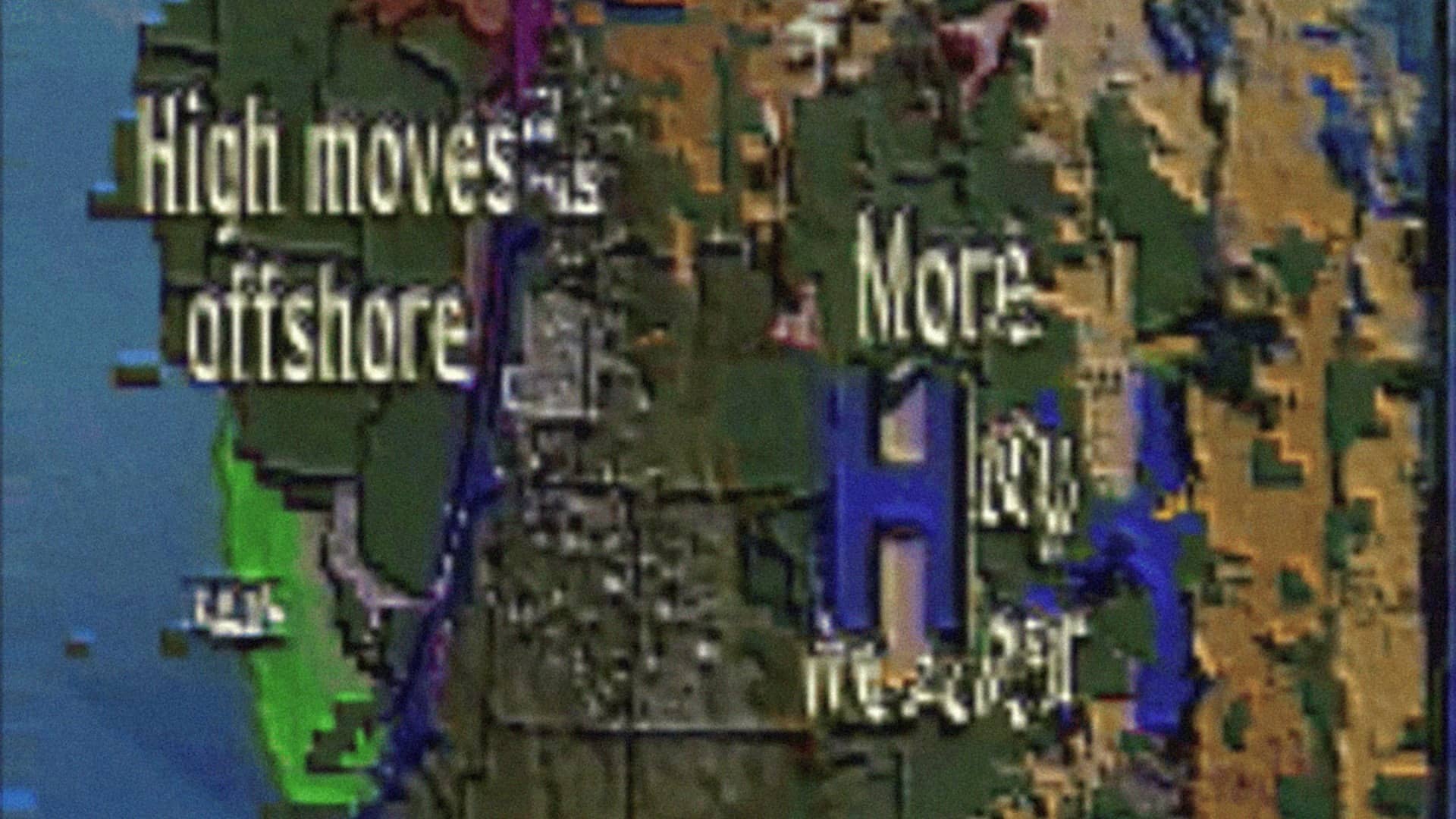
There is a forecast on screen. The map is familiar: fronts advancing, symbols pulsing, temperature bands sliding across a continent that could be anywhere. The grammar of public information hangs over the image, calm, procedural, designed to be trusted. Then the signal begins to fail. The map keeps moving.



This is the foundational logic of WEATHER CHANNEL, the series by DV Ghost arriving on Fakewhale ALPHA: five 1/1 animated GIFs built from AI generated video, archival weather broadcasts, and custom digital processing. Each work unfolds as a seamless loop. The broadcast material holds its familiar surface while image compression, signal instability, and codec behavior reorganize it from within. The forecast persists. The image becomes an environment.
DV Ghost is a web artist and experimental visual researcher working with controlled data corruption, signal decay, and the relationship between digital and analog media. The practice combines found footage and original AI generated material with datamoshing, signal interference, compression manipulation, and analog processes, producing unstable moving images that live between preservation and disappearance. Formed inside early internet culture and its degraded media, the work reads the glitch as a trace: of memory, of decay, of instability, of transformation.
WEATHER CHANNEL sharpens that reading by aiming it at the most public of image systems. Broadcast weather is television at its most institutional: prediction, reassurance, the daily administration of an unstable sky. DV Ghost lets that system meet its own instability, and the encounter recomposes it into something the schedule never planned for.
Corruption as Method
There is a decisive difference between the glitch as effect and the glitch as method. As effect, corruption arrives after the image: a filter, a texture, a stylistic signature applied to a finished surface. As method, corruption participates in composition itself. In WEATHER CHANNEL, image compression, signal instability, and codec behavior operate as formal decisions, reshaping familiar visual material into new environments rather than decorating it.

Each work is named in the flat vocabulary of the broadcast: High moves off shore, Midwest, Ray, Panel, Rainy. The titles carry an almost administrative neutrality, the phrasing of a pressure system in motion, a regional map, a graphic panel, a change in conditions. This flatness matters. The title names the technical language of prediction, while the work opens a field of instability around it. A caption becomes a landscape. A panel becomes weather.
The compositional consequence is precise. Because corruption operates at the level of encoding, its interventions inherit the logic of the material they transform. Datamoshing propagates motion vectors across frames that were never meant to share them; compression redistributes detail according to its own economy of bandwidth; interference introduces rhythms that belong to transmission itself. The resulting image carries two authorships at once: the broadcast’s original order and the encoding system’s reorganization of it.
Within this system the error stops functioning as an accident and starts functioning as grammar. The image is written in the language of its own failure, and that language proves unexpectedly rich: capable of tone, of pacing, of composition. What the broadcast loses in legibility it gains in presence.
The Loop as Duration
Broadcast television is a linear medium organized around the event. The forecast exists to be superseded: each bulletin replaces the last, each prediction expires on contact with the day it describes. The animated GIF inverts this temporal economy. A loop offers only a present that repeats, a duration folded back onto itself.
WEATHER CHANNEL builds its five works from fragments of longer broadcast sequences, reorganized into seamless loops. The reduction is generative. Once motion loops, movement stops describing an event and starts sustaining a state: a perpetual transition that arrives nowhere and completes itself continuously. The front keeps moving off shore. The rain keeps beginning.
Weather operates in the series less as a subject than as a condition. Constantly shifting and impossible to hold in a fixed state, it mirrors the nature of digital transmission, where images are continuously encoded, degraded, reconstructed, and reinterpreted. The loop makes that equivalence structural. Atmosphere and signal obey the same law: both exist only in transition, and both are legible only through the systems that measure them.
The loop becomes both the image and its duration. The forecast once promised a future; the loop withholds it, holding the viewer inside a weather that never resolves into a day.
The Apparatus of Decay

The workflow behind WEATHER CHANNEL is composite: AI generated footage, archival broadcast material, TouchDesigner, codec manipulation, and digital post production, with analog processes feeding the chain at various points. Each stage contributes its own logic and its own failure modes, and the failure modes are the point. The pipeline is engineered so that every system through which the image passes leaves a mark of its passage.
The inversion at the center of this apparatus deserves attention. Generative systems are engineered toward coherence: sharper detail, smoother motion, higher fidelity to a plausible world. DV Ghost runs the pipeline in the opposite direction, generating material in order to surrender it to entropy. The AI footage arrives clean and leaves corrupted. Synthesis provides the raw weather; decay provides the composition.
The codec functions here as a co-author with its own model of the image. Compression algorithms carry assumptions: about what the eye privileges, about which differences matter, about how much of a frame can be discarded before perception objects. When DV Ghost manipulates these systems, those assumptions surface as visible form. Block artifacts, vector smears, resolution collapse: each is the signature of a decision made by software about what an image is allowed to keep.
What emerges are landscapes that exist somewhere between environmental phenomena and computational artifacts. The sky in these works is also a file format. The storm is also a bitrate. The apparatus of decay renders the two indistinguishable, and the indistinction is the point.
The Necessary Error
Contemporary image production is converging on the seamless. Generative models improve by subtracting friction: fewer artifacts, fewer inconsistencies, fewer traces of process. The resulting images are statistically plausible surfaces, optimized toward a world that renders well and stores clean. An image economy of this kind has a blind spot, and the blind spot is history: the seamless surface arrives stripped of transmission history, free of any residue of the systems that produced it.
Inside this regime the glitch changes status. What once registered as technical failure now operates as a critical act: evidence that the image has a body, a transmission history, a mortality. Corruption certifies process. A compression artifact is an index in the classical photographic sense, a mark left by something that actually happened to the file.
Degradation, crucially, must be executed to be shown. A convincing decay is a real decay: the codec has to actually misfire, the signal has to actually break. In an era when any appearance can be synthesized, the artifact of process remains one of the few marks a synthetic image can carry as document rather than depiction. DV Ghost’s method builds on this asymmetry, treating each act of corruption as a small guarantee of event.
Deconstruction becomes, on these terms, a literacy for the generative era: a way of keeping visible the material life of images at the exact moment that material life is being engineered out of them. The corrupted signal argues for the image as event, as transmission, as something that can be lost. Against the frictionless surface, WEATHER CHANNEL proposes friction as meaning.
The Weather of Memory
Broadcast weather is one of the deepest reservoirs of shared televisual memory. For decades it organized a collective time: the evening bulletin, the regional map, the voice translating atmosphere into instruction. Its imagery is common property, carrying memories of television, prediction, and public information while remaining detached from any specific place or moment. In WEATHER CHANNEL that detachment is the material condition: the fragments arrive already generic, already everyone’s, and the corruption works on the memory as much as on the image.
Technological nostalgia functions here as raw material. The degraded media of early internet culture, the tape ghost, the low-bitrate stream: these return in the work as textures of memory itself, the visual form remembering takes once recall is stored in formats that decay. The corrupted file remembers the way a fading photograph remembers, through loss.
The series holds its images between preservation and disappearance and treats the two as a single process. To keep a digital image is to copy it, convert it, re-encode it; every act of preservation is also an act of transformation, and transformation accumulates as damage. The archive decays in the act of being kept. WEATHER CHANNEL makes that condition visible by accelerating it, letting five fragments of broadcast memory live inside their own erosion.
The title carries its full irony. A weather channel is a promise of continuity: transmission around the clock, prediction without pause, a sky permanently mediated. DV Ghost delivers the continuity and dissolves the promise. The channel transmits forever. The forecast never arrives. The loop holds everything except tomorrow.
DV Ghost is a web artist and experimental visual researcher exploring controlled data corruption, signal decay, and the relationship between digital and analog media. Working primarily with video art and GIFs, the practice combines found footage and original AI generated footage with datamoshing, signal interference, compression manipulation, and analog processes to create unstable moving images that exist between preservation and disappearance. Influenced by early internet culture and degraded media, the work investigates corrupted memory, technological nostalgia, and the aesthetics of interference. Glitches are approached as traces of memory, decay, instability, and transformation.
WEATHER CHANNEL
by DV Ghost
Live July 15, 2026
6:00 PM CEST / 5:00 PM BST
5 unique 1/1 animated GIFs
English auction, no reserve